Can Granola and Fireflies connect to your recruitment ATS?
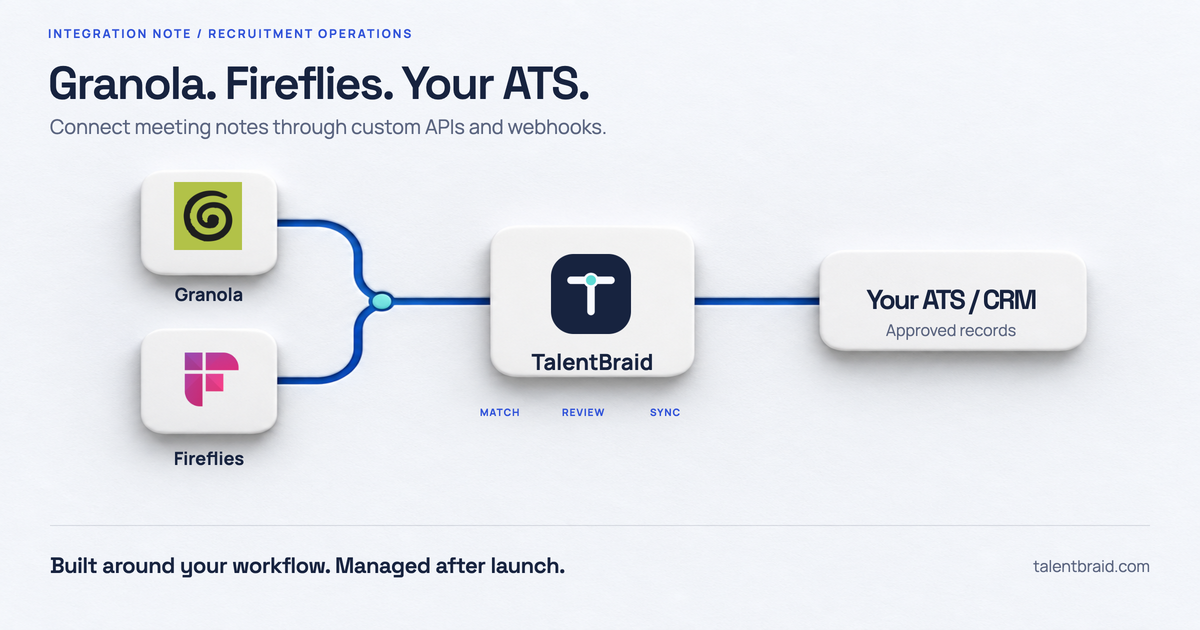
Granola and Fireflies can supply meeting information to a custom ATS or recruitment CRM workflow through their official APIs and webhooks. The destination must also provide an approved way to find records and write the required notes or tasks. TalentBraid can assess, build and manage that connection, subject to account access, permissions, endpoints and supplier terms. See the Granola API overview and Fireflies API overview.
The useful outcome is specific: an approved meeting summary attached to the correct recruitment record, with a clear next action and an owner. Connecting the apps is only part of that job.
This guide covers two alternative source routes, Granola to your ATS and Fireflies to your ATS. An agency does not need both meeting tools. The same design principles apply when assessing other third-party apps with usable integration interfaces.
Start with the record your recruiter needs
A candidate screening call can produce a useful summary while leaving the recruiter with several manual decisions. Which candidate does it belong to? Which vacancy was discussed? Is the availability statement confirmed? Who should follow up?
Moving the whole transcript into a general notes field leaves those decisions unresolved. Copying every extracted value into structured ATS fields can create a different problem: uncertain statements become operational facts.
Start by defining one approved output. For example, a screening-call activity linked to a candidate and vacancy, containing a reviewed summary, source link and follow-up task. Keep sensitive profile changes and candidate-facing messages behind recruiter approval.
Our meeting-notes-to-ATS workflow playbook explains the broader operating model. Here, the focus is the integration contract that makes that model work with Granola or Fireflies.
What the Granola API and webhooks provide
Granola exposes a REST API at https://public-api.granola.ai. Requests use an API key in the Authorization header as a Bearer token. Business workspace members can create keys; Enterprise administrators control member access scopes. Workspace keys have their own access rules, so confirm the intended note coverage during scoping. The API excludes notes that have not completed the required summary and transcript processing. Granola API access and limits.
For a Granola ATS integration, the retrieval route is GET /v1/notes/{note_id}. Relevant response fields include id, title, summary_text, summary_markdown, attendees, owner, web_url and calendar_event. Request transcript content only when necessary. Private notes have additional ownership restrictions and should be excluded from the integration mapping by default. Granola Get Note reference.
Granola webhooks are available on Business and Enterprise plans. Register a public HTTPS receiver through the product or POST /v1/webhook-endpoints. Use note.generated for the first summary and note.access_granted for notes shared after generation. Add note.edited only when the workflow has an explicit revision policy. Folder filters can narrow the scope. The notification identifies the note; the receiver then fetches its content. Granola webhook documentation.
Treat a later edit as a proposed revision to the existing activity. It should not silently replace a recruiter's corrections or create a second activity for the same meeting.
What the Fireflies API and webhooks provide
Fireflies uses GraphQL at https://api.fireflies.ai/graphql, with an API key supplied as a Bearer token. Use a POST request with a transcript query and pass the source meeting ID as the transcript ID. Check the account's actual access to the meetings the agency intends to process. Fireflies authorization and transcript query.
For a Fireflies ATS integration using Webhooks V2, choose meeting.summarized when the workflow requires a summary or action items. meeting.transcribed signals that the transcript is ready, which is a different milestone. The V2 payload includes meeting_id, event and timestamp. Fireflies documents webhook delivery for meetings owned by the configured user, identified by organizer_email. Test organizer coverage across recruiters before assuming one configuration covers the agency. Fireflies Webhooks V2.
Useful query fields include id, title, organizer_email, participants, transcript_url and summary. Within summary, overview and action_items are documented string fields. Action items therefore need parsing and validation before they become individual tasks with owners and deadlines. Fireflies transcript schema and summary schema.
Current documented API limits vary by plan: Free allows 50 requests per day, Pro 500 per day, and Business or Enterprise 60 per minute. These limits do not establish entitlement to every feature. Confirm webhook availability, summary fields and permissions in the target account, and include testing, retries and reconciliation in the request budget. Fireflies API limits.
Design the custom webhook and API workflow
A webhook tells your integration that something happened. An API request retrieves the data or performs an allowed action. A production workflow also needs a queue, a record-matching policy and an accountable response when something cannot be processed.
1. Agree the source and destination contract
Choose eligible meeting types, recruiters and folders. Define the destination object, required fields and permitted changes. Confirm that the ATS API can search the appropriate entity, create an activity, link it to the record and create a task if that is in scope.
An ATS may permit note creation without exposing task creation or the required custom fields. Confirm each operation separately. Use the destination's supported authentication method, with the narrowest practical permissions, securely stored credentials and a documented revocation process. Keep test and production credentials separate.
2. Verify the notification and queue the work
For Granola, verify the raw body using its Standard Webhooks signature scheme and enforce a timestamp tolerance. Its delivery deadline is 15 seconds. For Fireflies V2, configure a signing secret and verify the raw body against X-Hub-Signature using a timing-safe comparison; delivery requires a 2xx response within 10 seconds. Granola delivery verification and Fireflies webhook authentication.
Our recommended design is to validate the event, durably enqueue it, then acknowledge receipt. Do not wait for the ATS write inside the webhook request. Reject invalid signatures, constrain payload size and keep secrets and full meeting content out of ordinary application logs.
3. Match the correct recruitment record
Prefer an existing booking-to-record association that carries the destination record ID and meeting occurrence. Otherwise, evaluate participant email against the correct entity type and relevant job context. Exclude the agency's own recruiters from candidate matching.
One email can belong to a candidate and a client contact, or appear on duplicate records. A meeting can involve several candidates or several vacancies. Zero matches or multiple plausible matches should create a review item. A name-only match should not authorise a write.
4. Map only the fields you can defend
The following mapping is a proposed integration design. Destination field names depend on the ATS schema.
- External source key: source application, agency account and Granola note id or Fireflies transcript id. Store this in a mapping ledger or supported external-reference field.
- Activity subject: source title, with a controlled prefix such as Candidate screening. Validate length and remove unsupported formatting.
- Activity body: Granola summary_text or Fireflies summary.overview, after the agreed review and minimisation steps.
- Source link: Granola web_url or Fireflies transcript_url. Preserve the source platform's access restrictions rather than making a meeting public.
- Candidate and vacancy links: destination IDs resolved by the matching policy. Participant details are lookup evidence, not destination IDs.
- Recruiter owner: map Granola owner.email or Fireflies organizer_email to an active destination user. Missing owners go to the operations queue.
- Follow-up task: an approved action, mapped owner and explicit due date. Do not invent a deadline from an ambiguous phrase.
- Revision state: source version or content hash, mapping version, reviewer and destination activity ID.
Do not treat a note creation timestamp as the meeting start time. Do not convert a missing salary, currency or availability value into zero or an empty overwrite. Keep unresolved values visible for review.
5. Put review before consequential changes
A summary can be ready before it is approved. Have the recruiter review uncertain matches, extracted compensation or availability, candidate-facing communication and pipeline-stage changes.
Bind approval to the exact proposed content and destination record. If the source changes afterward, recalculate the proposal and request review again where relevant. Treat meeting text as untrusted data: statements inside a transcript must not change integration permissions or instruct a downstream AI step to bypass controls.
Prevent duplicates and recover without guessing
Deduplicate deliveries and destination writes separately. Granola retries reuse event_id. Its documented retry period is four days, and events missed while an endpoint is disabled are not replayed. Granola retry behaviour.
For destination writes, use a stable key built from agency account, source app, source meeting ID and destination record ID. An event ledger records processing attempts; a mapping ledger records the resulting ATS activity. Claim work atomically so two workers cannot create the same activity concurrently.
For Fireflies, do not depend on an undocumented universal delivery ID or assume Granola's retry behaviour applies. Use the meeting key and content state to suppress repeated writes. Fetch the latest permitted source state when handling updates, and prevent an older queued revision from overwriting a newer approved version.
Retry transient network failures, rate limits and recoverable server errors with bounded exponential backoff and jitter. Respect Retry-After when available. Authentication failures and invalid field mappings need intervention rather than an endless retry loop. Inspect GraphQL errors and required response fields as well as the HTTP status.
If the ATS accepts a write but the response times out, reconcile before retrying. Use destination idempotency support where available, or look up the stored external reference. If neither is possible, hold the ambiguous attempt for investigation instead of risking a duplicate.
Maintain a scheduled reconciliation process within the source account's available API filters and rate budget. Compare eligible accessible meetings with the processing ledger. This can detect missed notifications; it cannot recover content the account can no longer access or content already deleted.
A hypothetical screening-call example
An agency uses Granola for screening calls. A note becomes available, and the integration fetches its summary. A booking association identifies the candidate and vacancy, but the candidate's notice period is uncertain: they said they might be able to leave earlier.
The workflow prepares a screening activity and a task to confirm availability. The recruiter reviews the proposal, approves the activity and assigns the task. It leaves the structured availability field unchanged. A repeated notification resolves to the existing activity instead of creating another one.
With Fireflies, the equivalent workflow would start from the appropriate summary-ready event and retrieve the permitted fields through GraphQL. This is an implementation example, not a claim that TalentBraid has already delivered either named integration or achieved a measured result.
Give exceptions an owner after launch
Agree the operational responsibilities before enabling automatic writes:
- Recruiter: resolve ambiguous records and approve consequential content.
- Agency operations lead: maintain owner mappings, required-field rules and the review backlog.
- Technical integration owner: investigate credential failures, schema changes, queue delays and failed writes.
Test duplicate deliveries, missing summaries, revoked credentials, multiple record matches, edited notes, rate limits and ambiguous write timeouts. Launch with a limited set of users and compare source meetings against destination records before widening the scope.
Measure the percentage of eligible meetings that produce an approved, correctly linked activity within the agreed time window. Also track review time, manual corrections, unresolved exceptions and duplicate writes. State which meetings are eligible so excluded records do not disappear from the denominator without explanation.
These controls also improve the reliability of downstream reporting. See our guide to recruitment agency reporting beyond the ATS.
Keep candidate data within the agreed purpose
For EU-facing workflows, identify the lawful basis and explain the processing to participants, including any applicable recording or transcription requirements. Limit transferred fields to the recruitment purpose; a full transcript may contain personal details that do not belong in an ATS activity.
Define access, retention and deletion across the meeting app, integration queue, logs, backups and destination. Identify controller and processor roles, execute the relevant DPA, assess subprocessors and international transfers, and document rights-request handling. These controls reflect GDPR requirements including Articles 5, 6, 13, 28, 32 and Chapter V. Official GDPR text.
TalentBraid supports GDPR-compliant workflow implementations. The implementation must still be assessed for the actual engagement. Review our data-protection overview and DPA overview when defining scope. If additional AI processing is proposed, agree its purpose, minimum payload, provider, retention and processing region before enabling it.
When TalentBraid can help
Use a native connector when it already provides the required mapping, permissions and operating controls. A custom connection becomes useful when your agency needs recruitment-specific matching, linked records, review gates, exception routing or ongoing technical ownership beyond what that connector provides.
TalentBraid builds and manages the automation layer for recruitment agencies. Dedicated engineers scope, implement and validate the workflow, then monitor and maintain the agreed integration after launch. Each engagement has a dedicated technical point of contact through an account manager or engineer according to scope.
For Granola, Fireflies or an unlisted third-party app, usable API access, webhooks or an approved integration interface are the starting point. Final compatibility depends on the requested operations, permissions, authentication, limits, supplier terms and expected volume. Third-party subscriptions or usage costs are scoped separately.
Book a call with us through TalentBraid, or email [support@talentbraid.com](mailto:support@talentbraid.com). Send the app names, current manual process, desired outcome, expected volume and any available integration documentation. We will assess feasibility and a maintainable design before you commit.
Sources and further reading
- Granola API access, authentication and limits
- Granola Get Note endpoint and fields
- Granola webhook events, signatures and delivery behaviour
- Fireflies API overview
- Fireflies API authentication
- Fireflies transcript query
- Fireflies Webhooks V2
- Fireflies transcript schema
- Fireflies summary schema
- Fireflies API limits
- GDPR: official regulation